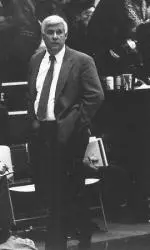
Catching Up with Former Head Men's Basketball Coach Jerry Waters
10/20/2009 12:00:00 AM | Men's Basketball
Oct. 20, 2009
SPARTANBURG, S.C. - Jerry Waters was named the seventh head men's basketball coach of USC Spartanburg in 1980. He came to the Upstate with a plethora of coaching experience in both the high school and college levels and administrative levels with knowledge of various sports.
Waters began his basketball coaching career in 1967 as an assistant at St. Andrews High School in Charleston, where he also took on responsibilities as the head baseball coach and assistant football coach. In 1970, he moved to Middleton High School where in addition to being the head men's basketball coach and athletic director from 1970-1978, he also served as the head golf coach and assistant football coach.
During his tenure at Middleton, Waters accrued more than 100 victories, including 54 consecutive wins, a South Carolina 4A record, and a perfect 28-0 season. His teams won four state championships and seven conference championships. He was named the South Carolina Coach of the Year three times for basketball and coached the South Carolina All-Star team twice.
Waters' records and successes spoke for himself in making him a candidate for the head men's basketball coaching position at USC Spartanburg. He took the position in Spartanburg after coaching at the University of the South in Sewanee, Tenn. for two years and leading his team to a second-place finish in the Southern Collegiate Athletic Conference in the 1979-1980 season.
Waters coached at USC Spartanburg for 17 years and in doing so, established himself as a legendary and respected coach who would be inducted into the University's Athletic Hall of Fame in 2000. Additionally, he served as athletic director and an instructor in the school of education for the University. He led the then-Rifles to the school's first national championship in 1982 as they defeated previously unbeaten Biola (California) University, 51-38, in the NAIA Tournament championship game, after guiding the Rifles to their first 20-win season during the 1980-81 campaign.
Under Coach Waters, the Rifles qualified for the NAIA National Tournament in 1981, 1982 and 1990. They won a NAIA District Six title in 1990 and a Peach Belt title in 1991, after being voted as the seventh-best team in the NCAA Division II Final Men's Top 20 Poll, amassing a 25-2 record during the season.
While coaching at Spartanburg, Waters amassed an impressive 364-133 record (.732 winning percentage), boasting a phenomenal 193-30 record at the Hodge Center. Waters also coached the team to a 50-game home winning streak, which started in February 1988, and was the second-longest at any level (NCAA I, II, III or NAIA) in the nation when it was snapped in February 1993. Before his final season with the Rifles, Waters was 23rd among active NCAA Division II coaches with 366 career victories and 14th in winning percentage (.708).
Waters' impressive resume of accomplishments as head coach at USC Spartanburg include three NAIA District Six Championships (80-81, 81-82, 89-90), two Peach Belt Athletic Conference Championships (90-91, 91-92), and one NAIA National Championship (1982). He also led the Rifles to three NCAA Division II South Athletic Regional Tournaments (1991, 1992, 1996).
Waters left Spartanburg after the 1997 season and joined the University of Georgia as an assistant coach. He returned to the Upstate area in 2007, taking the head coaching position for the boys' basketball team at Chapman High School. He is entering his third year as the head coach and physical education teacher.
Waters graduated from Belmont College with a B.S. degree in health and physical education and received his master's degree from South Carolina State College.
The former Upstate coach recently sat down with Joe Guistina of upstatespartans.com to discuss his time in Spartanburg.
After reading back through various articles, I discovered that you were a little worried that the opportunity to coach collegiately in the state of South Carolina would never come for you. How exciting was it for you to finally get that opportunity?
I had always coached in South Carolina at the high school level, even though I was from Georgia, South Carolina was home and I was excited at the opportunity to coach at the college level. My goal when I arrived here was to recruit every athlete from this state that I possibly could. We achieved that goal as we recruited numerous kids from this state and I felt that the best way to build the program here was to recruit in-state athletes. I was excited and thankful for the opportunity to coach here.
You had a strong nucleus of players waiting for you when you arrived on campus, describe what it was like to already have a talented group of players ready to play.
When I walked into this building, there were 18 guys in the gym on a Sunday night for a pickup game, just so we could see what type of players we had. Afterwards, I met with all of the athletes upstairs and I explained to each and every one of them exactly how it was going to be. I explained to them that academics came first and that we would have study hall at least three nights a week. I told the players that we were going to do things the right way and academics was our first goal. If we could get our academics in order then I knew that athletics would take care of itself. Even though we lost six players in the first month, we still had a strong group of 12 and that group led us to Kansas City in the first season.
Many people are not aware of the how competitive the NAIA tournament really is. In order to win the championship you must win five games in five days.
Five games in five days is tough enough, but then throw in the No. 1 team in the nation and it becomes even more difficult. They entered the tournament averaging 101 points per game and we were able to hold them to just 38. Most people, when I tell them that story, just stare at me and I know they think I am making it all up, but I am speaking the truth.
How difficult was it for you to keep your team focused day after day after day at the NAIA Tournament?
We tried to be as loose as possible and not try to get to worked up over things, unless we were on the court. As a team, believe it or not, we focused on our academics when we were not playing. We had a set schedule that we followed and it helped keep the players focused during our time in Kansas City.
Biola came into the game against your Rifles with a record of 39-0, how special was it to defeat one of the better teams in NAIA history?
Even though there is a banner hanging here in the Hodge Center honoring our national championship team, I still have to pinch myself to believe that it really happened. Just getting to Kansas City is an amazing feat on its own. Being able to beat quality teams such as the College of Charleston, Lander and Limestone and others in the area to be able to travel to Kansas City was phenomenal the first time. Then we did it again and we able to win the entire tournament that year. It was a great experience and having such a tight-knit group to do it with was amazing and it was all because of the graces of the good man upstairs.
You led the Rifles to a 50-game home winning streak and that included a district championship and another trip to Kansas City, just talk about those teams that you coached.
My son, Jeff, happened to be part of the streak along with Willie Murdaugh and several other quality players. We averaged 28 wins over those four seasons and it was very special. I almost didn't recruit my son to play here because I didn't want him to have to deal with the pressures of playing for his dad. He did an outstanding job and I am proud of the effort he gave. He had looked at other schools but he didn't feel comfortable going there, instead he told me he wanted to play somewhere that he could go and beat their rear-ends. And we did beat them and he was a big part of that.
Did you ever come to games when Coach Payne was coaching Luke or did you ever have conversations with Eddie about coaching his son?
I haven't ever talked with Coach Payne about coaching your own son, but I did attend various games during Luke's career here. Through the games I attended and the articles that I occasionally read, I could tell that it was a difficult struggle at times, due to the fact that he is the coach's son and he feels that he can never do quite enough.
You left Spartanburg for the University of Georgia where you became an assistant coach. What was that experience like for you?
It was like a dream come true for me. Good things were happening there and I went there because it was a great opportunity. My tenure, sadly, didn't last very long after being let go from my post after the head coach was fired. My other son was a manager for the basketball team, so it was nice to be able to spend time with him during my time at Georgia.
You are now the head coach at Chapman High School, what made you want to move back to the area?
When I left Georgia, I went to a school called Pinewood Christian Academy. Before my arrival they had never had a winning season and they barely had enough players for a pickup game of hoops. And in two seasons as the head coach, we finished the season as state runner-ups. The following two seasons we were able to win the state title. I was interested in coming home because Spartanburg was like home to me because I had been here for nearly 20 years. Also, my oldest son lived in the area and I would be able to spend time with my grandchildren. I just felt that it was the right thing to do from a family standpoint as well as a coaching standpoint.
USC Upstate recently received a gift of $4 million from Mrs. Dodie Anderson to renovate the Hodge Center. During your time here Mrs. Anderson and Dr. Hodge were huge supporters.
They were genuine people and it was great to be around them during my time here in Spartanburg. Both individuals were here when there was not a lot of growth at the university, but they remained loyal to the university as well as the community. We became a very close knit group of individuals and it felt like we were family. It is a thrill to see Mrs. Anderson giving such a generous gift to this institution and I can't wait to see what the new Hodge looks like about a year from now.