10 Questions With Diana Martinez
6/16/2008 12:00:00 AM | Women's Tennis
June 16, 2008
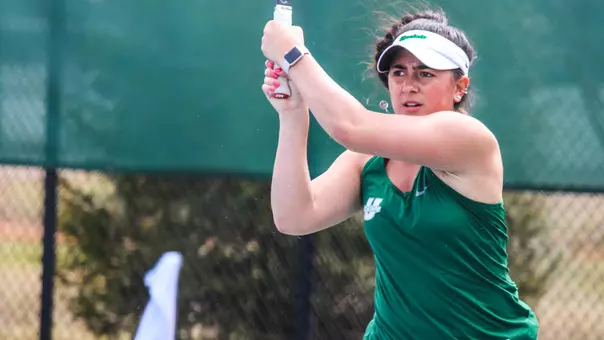
SPARTANBURG, S.C. - The accomplishments come rolling like an avalanche when you begin to talk about Diana Martinez' career at USC Upstate. A perfect 4.0 GPA. A school-record 73 singles wins in women's tennis. A school-record 64 doubles' wins. The school's first Atlantic Sun Conference Women's Tennis Player of the Week Award. The George Dean Johnson, Jr. College of Business and Economics School of Business and Economics' Marion McMillan Academic Excellence Award. Being a member of the first USC Upstate women's tennis team to reach the NCAA Division II Round of 16 in 2007. Being a member of the first Atlantic Sun Conference Championship women's tennis team in 2008.
It's been a special career for the Colombian and on Thursday, she joined one of the most select groups in collegiate athletics for the second time when she earned her second straight CoSIDA/ESPN: The Magazine Academic All-American award. Her name now rests alongside the likes of some of the most powerful people in athletics, including CBS Sports' analyst Cris Collinsworth, Boston Celtics' General Manager Danny Ainge and New York Yankees' Manager Joe Girardi. It also rests among some of the most brilliant, innovative and important people in the world, including former President and CEO of the Electric Power Research Institute (EPRI) Richard Balzhiser, U.S Federal Judge Carmac Carney and Astronaut Steven Smith.
UpstateSpartans.com's Joe Guistina sat down with Diana this weekend and talked to her about a variety of topics, including the impact of her parents on her academic work, winning the Atlantic Sun Conference title this year, macroeconomics, her repeat performance on 10 Questions, and of course, being an Academic All-American.
US.com: You found out that you were the school's first two-time CoSIDA/ESPN: The Magazine Academic All-American on Wednesday afternoon. How nice is it to be recognized for the second time for both your play on the court and your work in school?
Diana Martinez: I can't describe how happy and glad I'm about getting this award for many reasons. Like all our athletes, I came to Upstate for two reasons: to get a degree while playing tennis and to help finance my tuition. I wanted to do everything while I was here the best I could and I think that there is nothing better than being recognized for excelling at the two things that you came to do (play and study). Personally, that means that these four years of hard work were worth it.
US.com: You are also the school's first Division I Academic All-American and are on a list now with some of the brightest young minds and some of the world's finest amateur athletics. How cool is that?
DM: Well, I didn't know that. I hope that helps me take the next step in life. I think those kind of things are what make one's journey in life significant. I've always thought that people should be able to say and feel that you don't just live day by day, but that you should made a difference and challenge yourself to your fullest. I consider that so far I've lived by that and that has made me who I'm today. Besides, one of the ways to pay my parents and my family for everything they have done for me is making them proud of me, and they tell me every time how happy they are of who I am.
US.com: What was the toughest course that you had to take at USC Upstate? Why?
DM: I would have to say many. For example International Economics taught by Dr. Word was very hard because of the way he graded us on just four essay questions. It was a challenge to me because I'm not the kind of person who remembers a couple of key points and can write and write from there. I have to memorize everything, all the details. I wish I could be the other way! Another one was International Macroeconomic Theory taught by Dr. Rook, there was just too much information in that course.
US.com: How much of your success in the classroom was fostered by your parents' encouragement?
DM:A lot, and not because they forced me to study or anything like that. I think that they raised me and my brother the perfect way. My mom was doing her master's degree when we were little so we had her as an example and we used to sit next to her to study. My parents always helped us and made sure we did our homework until we were like eight and then we grew up, were responsible and didn't need someone to make us study. My parents always taught me that no one was going to do anything for me or give me anything for free in life. If I wanted to be a successful person, I'd have to work hard for it. I think that if parents force their kids to do something (in this case study), they won't do it. Sometimes my mom even told me not to study as much as I used to do!
US.com: You were the one on the court that clinched the match against nationally-ranked ETSU to help clinch a share of the Atlantic Sun Conference regular-season championship. In that match, you fought off two match points to come back and win. What was going through your head during that match?
DM: Everything was going through my mind, and I know if Tami knew it, she would've got mad at me because she always asked us just to think about the point we were playing at the moment. I was thinking about what would've happened if I win, or lost, mine and my teammates' happiness or sadness. I thought about that being the last chance that many of us had to win a conference regular season. I also thought about how hard we all had practiced and worked throughout the year, and basically that day in which everything was going to be decided. The funny thing is that I was more nervous while playing the match points I had to win the match than the ones I had against me.
US.com: Your women's tennis team won the Atlantic Sun Conference regular-season championship in your first year playing at the Division I level. How nice was the experience of getting to win the school's first women's tennis league championship with your teammates?
DM: I think that our experience is unique because we all had been together for three years except for Emilia who is a freshmen, but her personality and the friendship that we all built with her made it feel like she had been there for more than one year. With this team we had broken too many records: we got ranked seventh in the final national poll last year in Division II. We were the first women team to ever go to the round of 16, and as you said, we are the first women's tennis team that won the Atlantic Sun Conference regular-season. The good relations that we had with each other and our coaches makes it even better.
US.com: You were the first women's tennis player in school history to win the Atlantic Sun Player of the Week Award, but Anna Novo won it twice during the season. Next year, Anna will need just 10 singles wins and 15 doubles wins to break your school records in both categories. What advice do you have for her as she enters her final year and tries to repeat as A-Sun Player of the Year?
DM: Advice? That's a hard one. I think Anna needs no advice. She is a great athlete and person. She has beaten some of the best players in the country and I think she won't have problem next year. I would tell her just to do the same she has being doing and when she feels tired just think that she is in her last year and keep working hard because the fatigue goes away, but the satisfaction of knowing that she did her best and broke so many records will never disappear.
US.com: As someone who was regularly seen in the stands at all sorts of Upstate athletic events from men's tennis match to basketball and soccer games, besides the women's tennis team, what was your favorite thing to see or read about this year at Upstate?
DM: Even though the women and men's tennis team are obviously two different teams, I feel that we all are like one big family. We all felt happy for the victories of each other and sad about the losses. That is way I was always reading all the news about the guys and watching their matches when possible.
US.com: Which is harder to explain - the basics of a forehand in tennis or the theories in microeconomics?
DM: Both because I have to say that I won't be a good teacher since I'm very impatient and it's very hard for me to find ways to explain if someone doesn't understand something. I think that everything depends on what you are putting in practice more often in your daily life. If some of my friends that are taking economics classes ask me something that I've learned a long time ago, I won't remember and would have to read or do a search to remember, but you can ask me how to hit a forehand and of course I can tell you right now how. So I would have to say that the basics of a forehand are easier as long as you pay attention and don't make me repeat too many times. Just kidding.
US.com: Among all your achievements, you are now the first Upstate athlete to be featured on 10 Questions twice, which is fitting since you were a two-time Academic All-American. Where does being on 10 Questions twice rank among all your accomplishments?
DM: I would put it number one without thinking twice because back home sometimes I was not recognized for achievements either on the court or classroom. Of course I don't do things to get recognized of anything like that, but sometimes it is good to know that people besides your family of closest friends appreciate what you do. That is one of the things that me and my family like from this country, that every time they have a chance, people encourage you to keep working hard.
It is an honor to be on 10 questions twice because it means that the athletic department feels proud of what I have achieved and there is nothing more gratifying.