The Lasting Legacy of Coach Jerry Waters
9/11/2020 3:41:00 PM | Men's Basketball, General
Editor's note: USC Upstate Athletics recently sat down with James Holland and Rev. Odell Cleveland, former USC Spartanburg men's basketball standouts and members of the 1982 NAIA National Championship Team, to discuss the legacy of former head coach Jerry Waters, as well as Waters' book Born to be a Coach that was co-authored by Cleveland, and a video that was directed and produced by Cleveland under the same title. In the last few years, Coach Waters has retired from public life and resides in Claxton, Ga.
SPARTANBURG, S.C. – "We think the world of him, but it's because we understand him," said one of his former players. "He's a very complicated man, but he just wanted to win." While he was known to be demanding, legendary USC Upstate Hall of Fame Head Coach Jerry Waters can be credited with paving the way for success for the USC Upstate men's basketball program.
As a small town Georgia native, Waters always knew he wanted to be a coach from a young age. "All of my high school coaches were instrumental to me becoming a coach," he said. "I knew by the seventh or eighth grade that that's what I wanted to do."
Waters began his coaching career at St. Andrews Parish High School and won a state championship in his first season as an assistant coach. After St. Andrews split into two different schools, Waters made the choice to take on something new and became a coach at Middleton High School where he won four state championships during his time there.
From there, Waters took the head coaching job at the University of the South in Sewanee, Tenn. because it was a way for him to get into college coaching. "I was always wanting to climb the ladder as any young coach would," said Waters. "Then, that moved on into the opportunity for the USC Spartanburg job, which was a chance for me to be at a bigger school. I took that job and everything went well from there."
Coach Waters inherited a lot of talent upon arriving to USC Spartanburg (now USC Upstate), but quickly knew he was going to have to change the culture of the program. "When I first got there [to USC Spartanburg], I went in to watch a pickup game, and there were a lot of good players, but they hadn't been successful at winning for one reason or another," said Coach Waters. "I disciplined those guys. I told them we were going to have study hall four nights a week, and I was going to supervise it because we had some players who weren't doing well academically. We had to first of all set our priorities straight."
Academics were a big deal to Coach Waters. "If they were going to be in school and play basketball, they had to do the academic stuff because that's a lifelong thing," he said. "I set the guidelines, and we lost some players along the way. We went from about 18 to 11 in a matter of three weeks. But those 11 were very solid and they did their job in the classroom and worked hard, and we won the district and went to Kansas City [for the NAIA National Tournament] in the very first year."
One of those 11 players who stayed was USC Upstate Hall of Famer James Holland, now a senior associate commissioner for the Big South Conference.
"When Coach waters came in, he really instilled a great deal of discipline. You don't know it at the time what's going on. You just think this guy is being a tough guy and a mean guy, but really, he is instilling discipline and direction for the team and pushing everyone to be their best," said Holland, who was a junior during Coach Waters' first season in 1980-81. "I give Coach Waters a great deal of credit for his leadership with the direction of the program at the time."
It would seem like making it to the NAIA National Tournament in Coach Waters' first season would be a satisfactory accomplishment, but for Coach Waters, it was not enough. "Any time you're competing on a team, you always want your next year to be better than the previous season," said Holland. "Going into Coach Waters' second year, there was a great deal of focus on the fact that we didn't accomplish the ultimate goal the year before. It would have been easier to just say the school went to the national tournament his first year, pat yourself on the back, and get complacent, but Coach Waters made us feel like there was a lot of unfinished business out there."
The difference maker in Coach Waters' second season? Another USC Upstate Hall of Famer, Odell Cleveland.
Cleveland previously played for Coach Waters in high school and characteristically won a state championship under him. However, Cleveland was academically unable to follow his coach to Sewanee, so Coach Waters worked with Cleveland to get him into Lake City Community College in Florida. "In hindsight, when I was getting so many offers from other universities in Florida at the time, the coach at Lake City would always say, 'No I think you need to go back and work with Jerry at Upstate,' so I'm sure the two of them had conversations saying, 'Okay I'm gonna help get Odell down there, but by all means necessary I'd really like to have him back up here in two years.' So, when I graduated from Lake City, my grandfather, who raised me, and I decided that Upstate would be the best place for me. We had a couple other options, but my grandfather believed that Coach Waters was probably the best person for me at that time," said Cleveland.
It was a perfect fit as Coach Waters and Cleveland already knew each other's tendencies, strengths, and weaknesses. Additionally, the common ground was that both of them wanted to win.
And they did.
Going into Coach Waters' second year, Holland explains that the mindset wasn't necessarily to go in and win the national championship, but more so just to do better than the previous year in Kansas City.
"I can't speak for everyone on the team but for me, coming back after my junior year where we won our first game and lost our second game at nationals, it was 'okay if we can win two games, that'll be an improvement from the previous season,'" said Holland.
Cleveland largely credits the community support for the team's success during the regular season. "You had to show up to the games early to get a seat, games were packed, and they were turning people away," he said. "We were the junk yard underdogs in Spartanburg, and that's just kind of how we played. We weren't the fanciest team out there, but we played hard and won and the community rallied around us." Holland backed that claim up saying that their games were "the place to be" that season.
At the time, USC Spartanburg was being compared to the University of South Carolina and Clemson by professional sports writers. Some writers even went as far as to say the Rifles (now Spartans) were better than the Gamecocks or Tigers. "Of course, we never played, so you never know. But, at the same time, we felt like we had a pretty good team," said Cleveland.
"We had a very good and confident team. There were very few games we played where we didn't believe we were going to win before the game started," said Holland.
Those feelings changed as the team headed to Kansas City for the second consecutive year to face teams they hadn't faced before. However, the phrase that the Rifles lived by that season was "No Ifs."
"Odell credits me with that saying, but I never really thought about it, because at the time I was just living it," said Holland. "It's very simple. Toward the end of the game, no matter what the situation was, we would come together and I would say 'hey fellas, no ifs,' and basically it meant exactly what it says. When the game was over with, we didn't want to go back in the locker room and talk about what we 'coulda woulda shoulda' done to win the game – if I had made that free throw, if I had gotten that rebound, if I had taken the charge instead of fouling the guy. It was just an unofficial mantra we stuck with throughout the season."
Holland explains that the phrase grew on itself as the season progressed, and got even stronger at the national tournament as the Rifles found themselves up against an undefeated, nationally ranked Biola team in the championship game. "We had a seven or eight-point lead coming down the stretch and it was free throw time, they were fouling us, they were pressing us and we couldn't turn it over, we had to get rebounds,' he said.
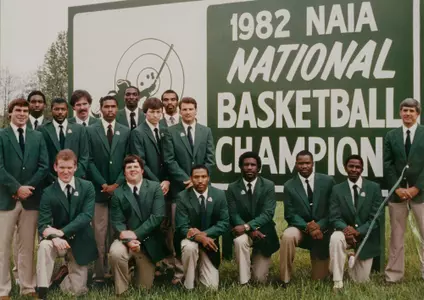
Holland is credited with the dagger in the championship game as the ball was inbounded to him before he drew a foul on a layup and made his free throw. There were "No Ifs" that season as USC Spartanburg defeated Biola to claim the 1982 NAIA National Title.
"I think our mental toughness along with Coach Waters' coaching ability, the team's commitment, and James Holland's leadership is what allowed us to win the national championship," said Cleveland. "We may not have been the best team ability wise, but at the same time, we had the biggest hearts, we weren't afraid, we believed in each other and played for each other, and I think that made all the difference."
Coach Waters continued to have success in Spartanburg even at the Division II level. After his 17-year stint at Upstate that, in addition to the 1982 National Championship, saw three NAIA District Six Championships, two Peach Belt Athletic Conference Championships, and three NCAA Division II South Atlantic Regional Tournament appearances, Coach Waters moved up to the Division I level to be the assistant coach at the University of Georgia in 1997.
Upon parting ways with UGA, Waters remained in Georgia and took an opportunity at MacIntosh Academy where he served as a middle school guidance counselor, athletic director, and golf coach for one year before taking the reins and turning around the boys' basketball program at Pinewood Christian Academy. "We had a lot of success at Pinewood doing what I had done throughout the rest of my coaching career, which was getting the best players and putting them in the best position they were suited for and running a lot of the same plays I ran at the college level. Over the seven years I was there, we won three state championships, and nobody would have ever thought that would have happened," said Waters.
Waters then returned to South Carolina when he took the position at Chapman High School where he made the state playoffs three out of his four years as the coach there. That is where he would eventually retire from coaching in 2012 with 859 career wins spanning 47 years.
"I think the whole Georgia experience was good for Coach Waters because he's a Georgia boy and loved the University of Georgia," said Cleveland. "At the same time, it's college sports so things happen, and the University decided to go in another direction. The reason he was so successful in every transition is the fact that he wanted people who would win. He really didn't care as much about who you were as a player, meaning 'Oh I like Odell so I'm gonna let him play over John who I don't like but is more talented.' No, he wanted to win. So, when that was on the line, nothing else mattered to him. He wanted to put the best team forward because above everything else, Coach Waters wanted to win. That's how I think he was able to transition from a USC Upstate to a University of Georgia to a high school, because he was brilliant. When it came to basketball and the X's and O's, he was just brilliant."
"If you look at his history, Coach Waters won at every level everywhere he went, and that's not just happenstance. There's something a person has in them that they can create in others – pushing people to get outside their comfort zone just enough without pushing them away or breaking them," Holland explained. "We had some very intense practices at times and sometimes, very good players were on the verge of saying 'I can't do this.' I was one of them my senior year. But, you go home, you relax, take a shower and lay down, and realize that 'hey I'm getting better.' That mindset is credited to Coach Waters. The psychology of coaching back then probably wasn't like it is now – getting in people's minds, making them believe in something they don't think they can do, and holding them accountable."
Coach Waters' coaching philosophy of "Championships are won at every level through hard work, developing chemistry, and obvious talent," played out at every stop he made. Another one of his philosophies that always played out was "Teaching your players to become a part of your system is very important. Every player must accept their role and it's up to us to explain it and expect it."
"Coach Waters really held us accountable for our roles on the team. People recognized and understood when somebody else wasn't doing what they were supposed to be doing, and Coach Waters would let you know also if you weren't doing what you were supposed to be doing," said Holland. "Roles were very defined. Just like on any team, guys can start getting outside themselves and start doing things they aren't supposed to be doing, and Coach Waters was very quick to bring you back to what you were supposed to be doing and what was going to keep you on the court."
"Coach Waters' most important aspect was when the game was on the line. When the game was on the line, Jerry Waters didn't flinch. That's something I've taken with me in my life," said Cleveland. "People ask me all the time how I deal with so many stressful situations and it's like okay what do you do with three seconds on the clock? That's the difference between winning and losing a state championship. Why don't you panic when you're down by 10 with 3 minutes left in the game? Are you able to hit that free throw when there's two seconds on the clock when the game is on the line? You're able to stop the hands of time – it's called a timeout – and then you evaluate. All of those are things I picked up under Jerry Waters that I take with me in my life today."
"As I think about the players that played for me over the years at every level, I always think about them as people. I want to know something about their background because all of them are different, and I always want to know as much as I can about them," said Coach Waters. "I always want players who want to give of themselves and be a part of something bigger than themselves."